
High frequency indicators, like vehicles sales, air traffic, steel consumption and GST E-way bills, point towards a sequential pickup in momentum of economic activity during the second half of the fiscal 2024-25 and sustain moving forward, RBI Bulletin said on Wednesday. However, a strong dollar, driven by US economic resilience and trade policy pivots, could exacerbate capital outflows from emerging economies, push risk premiums higher, and intensify external vulnerabilities, said an article on 'State of the Economy' published in RBI's February bulletin.

There is much work to be done to design a good GST.

'The path beyond diesel is not going to be clear. It is really going to be dependent on applications.'
Over 100,000 small and medium-sized businesses are non-compliant with e-invoicing norms under the goods and services tax (GST) regime, a mandatory requirement for businesses with an annual turnover of over Rs 5 crore. E-invoicing provides real-time access to invoices that are prepared by the supplier on the purchase of goods, allowing faster accessibility to input tax credit, thereby limiting the manipulation of fake credit as it has to be generated before the transaction. "The default has been reported mainly in businesses with a turnover between Rs 5 crore and Rs 20 crore," a senior official informed

'If weak indicators persist, there is a risk that India could slip into a prolonged slowdown similar to the one experienced between 2014 and 2019,' warns Debashis Basu.

GST officers can now launch prosecution against offenders in cases where the amount of evasion or misuse of input tax credit is more than Rs 5 crore, the finance ministry has said. However, this monetary threshold will not be applicable in the case of habitual evaders or in cases where arrests have been made at the time of investigation. "One of the important considerations for deciding whether prosecution should be launched is the availability of adequate evidence," the GST investigation wing under the finance ministry said, while issuing instructions for launching prosecution.

While liquidity in the banking system has turned surplus in the last few weeks, it could go back to deficit again, mainly due to corporate advance tax outflows. The net liquidity surplus of the banking system rose to touch Rs 1 trillion on Tuesday on the back of government spending, according to the data released by the Reserve Bank of India.

To shed more light on how GST will affect the individual as well as the nation, Rediff Chat has lined up experts to field your queries.

About 99,165 electric cars were sold in India in 2024, but electric car penetration -- share of electric car sales in total sales -- was just about 2.5 per cent.

The government should bring natural gas under the Goods and Services Tax (GST) regime to realise Prime Minister Narendra Modi's vision for a gas-based economy and raising the share of the environment-friendly fuel in India's energy basket, an industry body that represents the likes of Reliance Industries as well as state-owned firms, has said. Natural gas is currently outside the ambit of GST, and existing legacy taxes -- central excise duty, state VAT, central sales tax -- continue to be applicable on the fuel. In its pre-Budget memorandum to the finance ministry, Federation of Indian Petroleum Industry (FIPI), which boasts of members from across the oil and gas spectrum, also demanded rationalisation of GST on transportation of natural gas through pipeline as well as on re-gasification of imported LNG to help bring down cost of the environment friendly fuel.

Tomato prices have been on the boil for more than a month. Data from major cities show that the spike has been between 125 and 150 per cent at the wholesale level. Soaring vegetable prices, including tomatoes, pushed the retail inflation rate to a nine-month high of 5.49 per cent in September, according to government data. Though reports say prices are expected to come down in the next few weeks after supplies improve from Madhya Pradesh and Himachal Pradesh, how long will the respite last is anybody's guess.
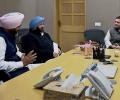
Simpler GST structure will be key poll plank, Congress sources tell Archis Mohan.
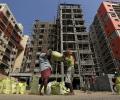
The biggest risk in under-construction projects is delay and non-completion.

'The bull market cycle ran for five years. It's the end of that cycle.' 'The next cycle is a down cycle, and in that down cycle, you will see the Sensex falling from their highs of around 68,000 to maybe 40,000-50,000 at the bottom of the cycle.'

President Droupadi Murmu addressed both Houses of Parliament, highlighting the government's achievements in various sectors, including economic growth, social welfare, and infrastructure development. She emphasized the government's efforts to lift the economy out of "policy paralysis" and create a more inclusive society. Murmu also acknowledged the challenges posed by digital fraud and cybercrime and stressed the need for a social infrastructure revolution. The President's speech is considered a policy statement, outlining the government's vision and roadmap for the future.

Recent documents by NITI Aayog and periodic labour force surveys on employment show that the importance of agriculture is rising in the Indian economy.
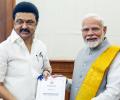
With its age-old fascination for education, southern states have done better than the North. Start-ups, IT hubs, and industry majors setting up shop have changed the face of the South. Nearly 79% of global offices set up by international conglomerates in India are in the South. Almost 46% of tech unicorns are from the South. The GDP per person in the South is 4.2 times higher than the North. None of these indicators can be ignored by any central government, whatever the political compulsions, notes Ramesh Menon.

Durable, automobile and real estate players have been lobbying hard for a tax cut, saying it will boost demand.

The Supreme Court of India has released an inquiry report into the alleged discovery of a large amount of cash at the residence of Delhi High Court judge Yashwant Varma. The report, which includes photos and videos, was uploaded on the court's website. Chief Justice of India Sanjiv Khanna has formed an in-house committee to investigate the matter and has asked the Delhi High Court Chief Justice to not assign any judicial work to Justice Varma. Justice Varma has denied the allegations, claiming they are part of a conspiracy to frame him. The inquiry report, submitted by the Delhi High Court Chief Justice, has been made public and calls for a deeper probe into the incident. The incident has raised concerns about judicial accountability and has prompted the Congress party to call for strong measures to uphold public trust in the judiciary.

Lack of visibility on rates makes companies apprehensive.

'Every year, the marble industry is shrinking due to tiles. It has already decreased by 20-25 per cent in recent years.'

It appears that things will crystallise on several aspects of the GST only by end 2008. This means that the country will only have a period of 15 months, from beginning 2009 to March 2010, to ensure that all the constitutional policy and legislative changes take place. It does seem increasingly a big challenge, says S Madhavan.
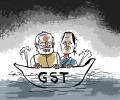
The government on Tuesday informed Rajya Sabha that GST compensation of Rs 17,176 crore is pending to states as on June 2022. Replying to supplementaries during the Question Hour, Minister of State for Finance Pankaj Chaudhary said the Centre is giving GST compensation to states for five years. He said even during Covid times when no GST was collected, the Government of India had given compensation to states after taking loans of Rs 1.1 lakh crore and 1.59 lakh crore during 2020-21 and 2021-22.

India studied the Malaysian model, which was scrapped on Wednesday, before implementing the GST and borrowed the anti-profiteering clause to ensure GST benefits are passed on to the end-consumer by the industry
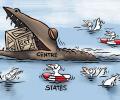
In signs of acceleration in economic activity, India's tax collections on goods sold and services rendered returned to over Rs 1 lakh crore in July after the second wave of Covid-related restrictions caused a blip in the previous month. Goods and Services Tax (GST) mop-up grew 33 per cent year-on-year in July to over Rs 1.16 lakh crore, indicating that the economy is recovering at a fast pace. In July 2020, the collection was Rs 87,422 crore. This is the second highest collection so far this fiscal after a record Rs 1.41 lakh crore mop-up in April.

The Appellate Authority for Advance Rulings (AAAR) of Gujarat has held that papad fryums would not attract any goods and services tax (GST) as they are similar to traditional round papads in all respects. In this connection, the appellate authority modified the ruling of the authority for advance rulings (AAR), which had ruled that Fryums would attract 18 per cent GST. The AAAR held that Fryums is a brand and not a generic name of the product, Harpreet Singh, partner, indirect taxes at KPMG in India said while explaining the order.

The Centre has recovered around Rs 95.86 crore from at least 11 crypto exchanges for evading goods and services tax (GST), according to data released by Parliament on Monday. The amount includes interest and penalty. The GST investigation department has detected a total tax evasion of Rs 81.54 crore by crypto exchanges that include WazirX, Coin DCX, CoinSwitch Kuber, Buy Ucoin, UnoCoin and Flitpay, among other exchanges. In a written reply to Lok Sabha, minister of state (MoS) for finance Pankaj Chaudhary said 11 cases of GST evasion by cryptocurrency exchanges have been detected by central GST formations.

The old India was economically fragmented. New India will create one tax, one market, one nation, said Jaitley.
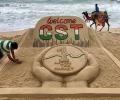
The collections from Goods and Services Tax (GST) grew by 15 per cent to over Rs 1.49 lakh crore in December 2022, indicating improved manufacturing output and consumption demand, besides better compliance. This is the 10th month in a row that the revenues have remained above the Rs 1.4 lakh crore mark. The collection in November was about Rs 1.46 lakh crore. "The gross GST revenue collected during December 2022 is Rs 1,49,507 crore, of which CGST is Rs 26,711 crore, SGST is Rs 33,357 crore, IGST is Rs 78,434 crore (including Rs 40,263 crore collected on import of goods) and cess is Rs 11,005 crore (including Rs 850 crore collected on import of goods)," the ministry said in a statement.

The government on Monday announced the implementation of a 5 per cent uniform IGST rate on all aircraft and aircraft engine parts to boost the industry. The decision, which comes into force with immediate effect, marks a significant milestone for the domestic Maintenance, Repair, and Overhaul (MRO) industry, aimed at making India a global aviation hub, an official release said. Earlier, IGST rates on all aircraft and engine parts were ranging from 5 per cent to 28 per cent.
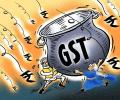
All GST anti-profiteering complaints would be dealt with by the Competition Commission of India (CCI) from December 1 as the extended tenure of National Anti-profiteering Authority ends this month, an official said on Tuesday. A notification in this regard is expected to be issued by the finance ministry later this month, the official added. The National Anti-profiteering Authority (NAA) was set up in November 2017 under Section 171A of Goods and Services Tax (GST) law to check unfair profiteering activities by registered suppliers.
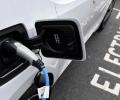
Proliferation of home chargers of around 7 KWh and above, which take six to seven hours to fully charge a car depending on the model, bring running costs down by a third or so. That, coupled with the increasing range of modern electric cars, can lead to a massive increase in sales.

This is a moment when the leaders at the Centre and states must show true leadership for the sake of the country. And it is the top political leaders, not attorney generals or bureaucrats, who should be sitting together and settling this thorny issue of compensation, says Arvind Subramanian, former Chief Economic Adviser to the Government of India.
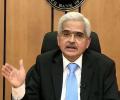
Reserve Bank Governor Shaktikanta Das on Tuesday said the fiscal-monetary coordination was at its best during the last six years even as he thanked Prime Minister Narendra Modi for giving the opportunity to head the monetary authority of the country. Das, in a series of posts on X, on his last day of his six-year term as RBI Governor, also thanked the Finance Minister, various stakeholders and his colleagues at the central bank.
Experts warn of over-interpreting the numbers and said their sustainability needed to be watched beyond November, says Indivjal Dhasmana.

The Supreme Court on Thursday ruled that the Goods and Service Tax (GST) Council's recommendations are not binding on Union and State but have a persuasive value as the country has a cooperative federal structure.

'Spend, but create assets, spend but make sure that people benefit from it.' 'This has been a beautiful guiding principle. And I think as a finance minister I owe so much to the prime minister for keeping this path clear before us.'

Headline growth was quite weak heading into the Covid period but averaged 6.4 per cent and 6.7 per cent in the five years between FY16 and FY20 for GVA and GDP respectively, points out Abhishek Upadhyay.

India SME Forum, an organisation for small and medium businesses, has called for creating a dedicated fund of Rs 5000 crore for the export capacity development, promotion, and marketing of Micro, Small & Medium Enterprises (MSMEs) in its Budget recommendation. The forum for MSMEs with over 98,000 members said that to enhance India's global competitiveness and increase its market share in global exports, it was "crucial to increase the number of active exporters and enable at least 3-4 lakh first-time micro, small, and medium exporters while supporting them in promoting Indian products globally."
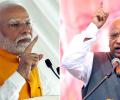
Kharge's remarks came after Modi on Friday said the Congress stands "badly exposed" in front of people for promising to them what the party knows it will never be able to deliver.
 © 2026 Rediff.com - Advertise with us - Disclaimer - Privacy Policy - Sitemap - Feedback - About us - Terms of use - Grievances